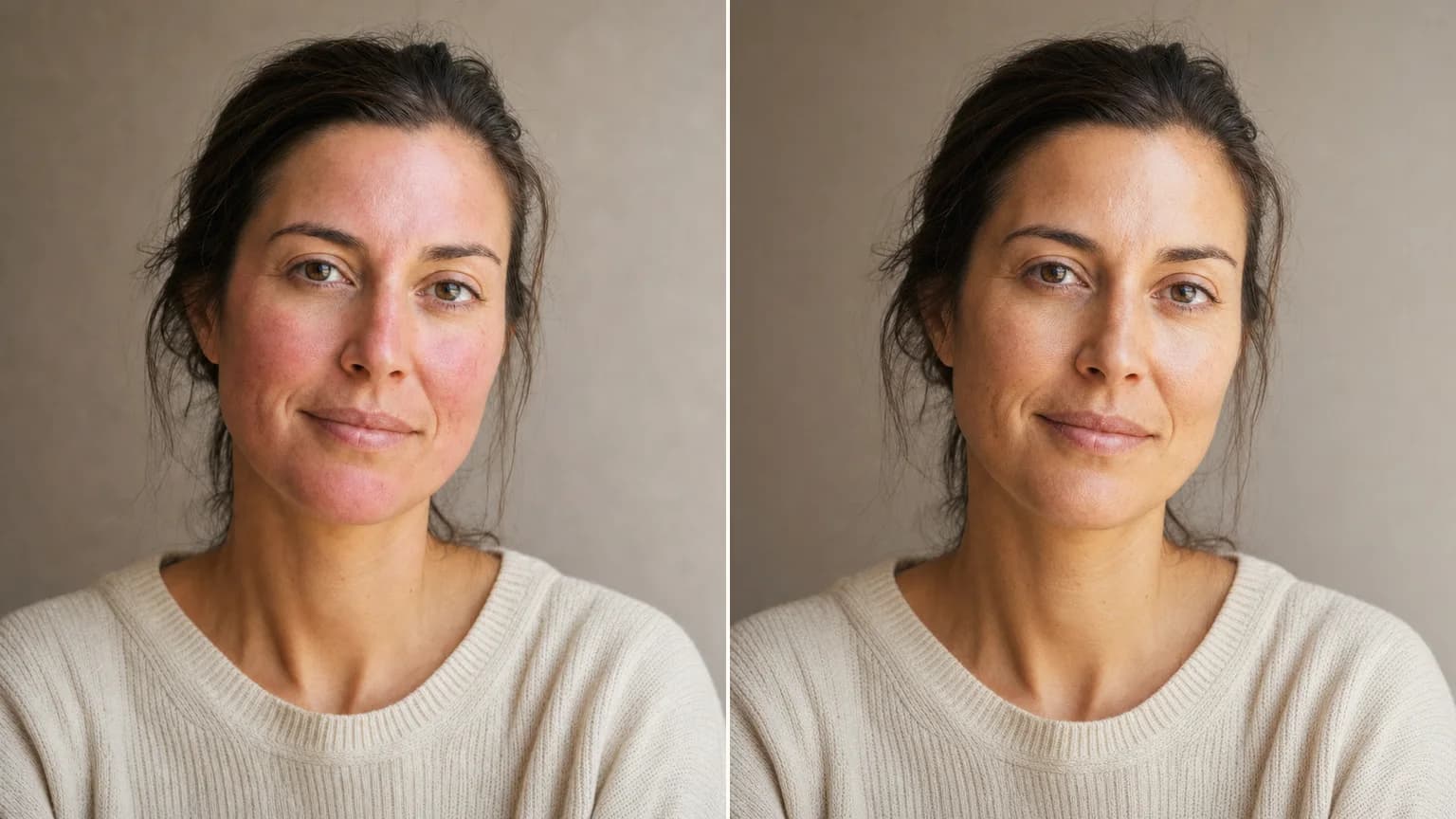
About 5% of adults have rosacea: a 2018 meta-analysis of 32 studies and roughly 26.5 million people put it at 5.46% of the general population[1]. Many people with mild redness are never diagnosed, so plenty of clients who book a color analysis have some redness without knowing it is shaping their results.
Skin color is three pigments in layers
Your visible skin tone is a blend of three pigments. Redness changes only one of them, but it changes how all three read together.
| Pigment | Where it comes from | Color it adds |
|---|---|---|
| Hemoglobin | Blood in small vessels near the surface | Red, pink |
| Melanin | Pigment cells in the skin | Brown, tan |
| Carotenoids | Plant pigments from food, stored in the skin | Yellow, golden |
Rosacea widens the small blood vessels and adds inflammation, so hemoglobin takes over. Red layered over yellow reads as ruddy pink, and the golden layer underneath gets hidden. When the redness calms, that golden tone shows through again. It was there the whole time.
Diet feeds the golden layer too. In a small 2012 study, people who ate more fruit and vegetables had measurably more golden skin within six weeks, the change tracked carotenoids rather than melanin, and other people rated the new look as healthier[2].
Redness tints the whole face, not only the red patches
A flare on the cheeks or nose changes how the entire face reads, for two reasons.
- The redness is wider than it looks. Rosacea often brings a faint background flush across the cheeks, nose, chin and forehead. People don’t register it as “red.” It simply shifts the overall tone toward pink.
- The eye averages a face. Viewers don’t judge skin patch by patch. They read the face as one impression, so a few red areas pull the whole face pink, even where the skin is clear.
That combined, slightly pink average is what every drape gets compared against during an analysis.
Common misreads during a flare
| What the analyst sees | What may really be going on | Likely result |
|---|---|---|
| Pink, rosy undertone | A warm, golden undertone hidden under redness | A warm person typed as cool (Autumn read as Summer) |
| Warm colors make the face look flushed | Orange, coral and red echo the redness and amplify it | Warm palettes rejected that would suit calm skin |
| Cool pinks look “harmonious” | Pink drapes blend into the flush and hide it | A cool palette picked because it camouflages redness |
| Higher contrast than expected | Red patches against lighter skin read as extra contrast | A palette that is too bright or too strong |
| Green or olive drapes look striking | Green is the complement of red and cancels it | An olive or muted read that is really color correction |
The common thread: the drapes are responding to the redness, not to the person’s underlying coloring.
How to get an accurate analysis with rosacea
Time the analysis for calm skin, and read the undertone from places rosacea doesn’t reach.
For clients
- Book on a calm-skin day, not during or right after a flare.
- Avoid common triggers for 24 hours before: alcohol, spicy food, hot drinks, intense exercise, hot showers and strong sun.
- Arrive bare-faced, without green color corrector, which would also skew the result.
- Mention rosacea or regular flushing up front, so the analyst can account for it.
- If your analysis is done from photos, take them in daylight after resting indoors for 20 minutes, so any exercise or cold-air flush has faded. Our guide to virtual color analysis covers the full photo routine.
For analysts
- Ask about redness, flushing and rosacea at intake.
- Read undertone from low-redness areas: the jawline, neck, inner wrist and the skin behind the ear.
- Judge drapes on eyes, hair and overall harmony as well as on skin.
- Treat “green looks amazing” or “pink calms everything” as a possible redness effect, not proof of a season.
- When results feel borderline, offer a recheck once the skin has been calm for a few weeks.
If you analyze from photos in Hathaura, you sample skin, hair and eyes yourself and always make the final call, so you can pick a low-redness spot on the jaw or neck and override a result that looks pulled by a flare.
The takeaway
Your colors belong to your underlying coloring, not to a flare. If your analysis was done on a red day and your palette never quite felt right, it may be worth redoing once your skin is calm. Many people find their true palette is warmer and more golden than they were told. See how Soft Autumn and Soft Summer differ (a mix-up redness can cause when it pulls a warm face cool), or find your season free.
This article is about color, not medicine. For diagnosing or treating rosacea, talk to a dermatologist.